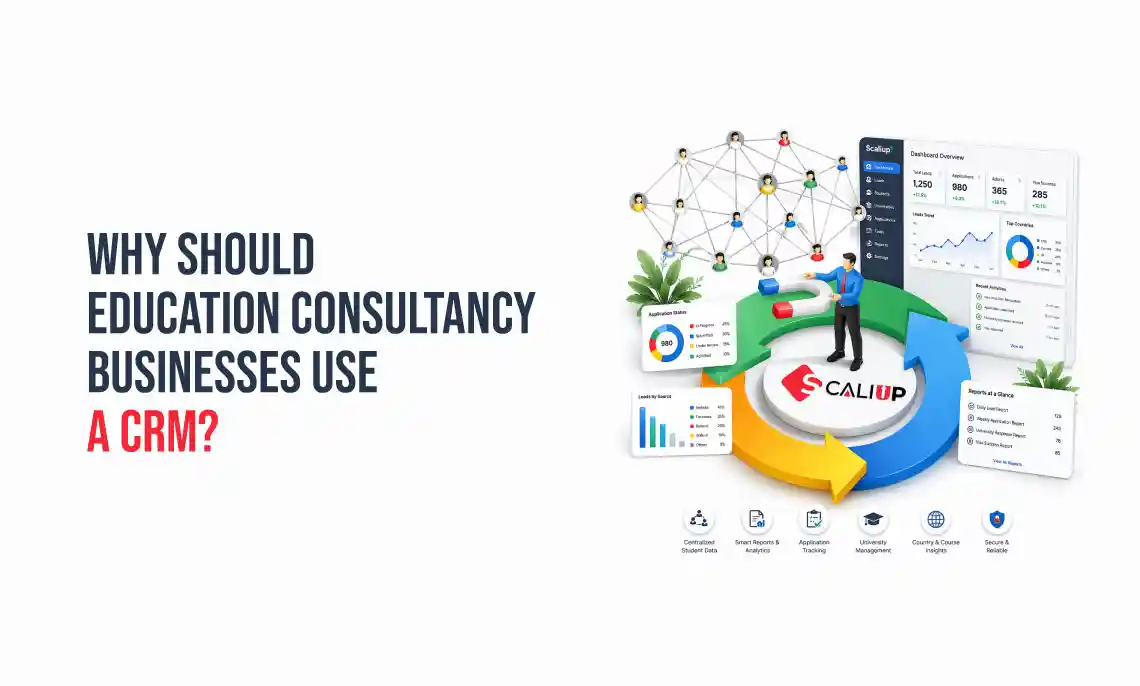
Why Should Education Consultancy Businesses Use a CRM?
In today’s competitive global education market, study abroad
consultancies are under increasing pressure to manage leads efficiently,
convert students faster, and deliver a seamless experience from inquiry to
enrollment. Yet, many consultancies still rely on spreadsheets, scattered
communication tools, and manual tracking systems. This outdated approach not
only wastes time but also leads to missed opportunities and lost revenue.
This is where a Customer Relationship Management (CRM)
system becomes a game changer.
A CRM is not just a tool; it is a complete business solution
that helps education consultancies streamline operations, improve conversion
rates, and scale sustainably. In this article, we will explore why adopting a
CRM is essential for modern education consultancy businesses.
1. Centralized Lead Management
One of the biggest challenges for consultancies is managing
leads from multiple sources such as Facebook, websites, walk-ins, and
referrals. Without a centralized system, leads often get lost or ignored.
A CRM brings all leads into one platform. Every inquiry is
captured, organized, and tracked. Consultants can easily view lead status,
assign responsibilities, and ensure timely follow-ups. This centralized
approach increases accountability and ensures no potential student is
overlooked.
2. Structured Student Journey
From the first inquiry to visa approval, the student journey
involves multiple stages. Managing this manually can quickly become chaotic.
A CRM allows you to define a structured pipeline: Lead →
Follow-up → Application → Offer Letter → Payment → Visa → Enrollment. Each
stage is clearly visible, making it easy to track progress and identify
bottlenecks.
This structured workflow ensures consistency and improves
the overall efficiency of your operations.
3. Improved Follow-Up System
Follow-ups are critical in converting leads into enrolled
students. However, manual follow-ups often result in delays or missed
opportunities.
With a CRM, you can automate reminders, schedule calls, and
track communication history. Consultants receive timely alerts, ensuring every
lead is nurtured properly.
This significantly improves conversion rates and builds
stronger relationships with prospective students.
4. 360-Degree Student Profile
Education consultancies deal with extensive student
information, including academic records, test scores, documents, and
preferences.
A CRM provides a comprehensive student profile where all
data is stored in one place. This includes personal details, academic history,
IELTS scores, passport information, and application status.
Having a complete view of each student enables better
decision-making and personalized counseling.
5. Efficient Application Management
Managing multiple applications across different universities
and countries can be overwhelming.
A CRM simplifies this process by allowing you to track
applications, manage deadlines, and monitor status updates. You can easily see
which applications are in progress, approved, or rejected.
This reduces errors, improves coordination, and ensures a
smoother admission process.
6. Financial and Commission Tracking
Many consultancies struggle with tracking income, expenses, and commissions from partner institutions.
A CRM with built-in financial features allows you to manage
payments, track commissions, and generate financial reports. You gain complete
visibility into your revenue streams and profitability.
This financial clarity helps in better planning and business
growth.
7. Enhanced Team Productivity
In a growing consultancy, managing team performance becomes
crucial.
A CRM enables you to assign leads, track activities, and
monitor individual performance. Managers can see who is performing well and who
needs support.
This transparency boosts accountability and motivates the
team to perform better.
8. Data-Driven Decision Making
Without proper data, decision-making becomes guesswork.
A CRM provides real-time reports and analytics on leads,
conversions, revenue, and team performance. These insights help you identify
trends, optimize strategies, and make informed decisions.
Data-driven businesses are always more competitive and
scalable.
9. Improved Customer Experience
Students expect quick responses, personalized guidance, and
a smooth application process.
A CRM ensures timely communication, organized data, and
efficient service delivery. This enhances the overall student experience and
builds trust in your consultancy.
Satisfied students are more likely to refer others, creating
a powerful growth loop.
10. Scalability and Growth
As your consultancy grows, managing operations manually becomes impossible.
A CRM provides the foundation for scalable growth. Whether
you have a small team or a large organization, the system adapts to your needs.
You can handle more leads, process more applications, and
expand your business without losing control.
Conclusion
The education consultancy industry is evolving rapidly, and
businesses that fail to adapt risk falling behind. A CRM is no longer optional;
it is a necessity for growth, efficiency, and competitiveness.
By centralizing operations, automating processes, and
providing valuable insights, a CRM empowers consultancies to work smarter, not
harder.
If you want to increase conversions, improve team
productivity, and deliver exceptional service, investing in a CRM is the right
step forward.
From the first lead to final visa approval, a CRM ensures
everything is managed seamlessly in one place.
Now is the time to move beyond spreadsheets and embrace a
smarter way of running your consultancy business.